
 EN
EN VN
VN

 09/09/2026
Thematic
LEGO Binh Duong: FDI Green Factory and KH Shield Materials

08/07/2026


NỘI DUNG BÀI VIẾT
- LEGO Binh Duong: FDI Green Factory and KH Shield Materials
- LEGO Binh Duong and a Higher Sustainability Standard for FDI Factories
- ESG Is Not Only About Renewable Energy
- Environmental – Reducing Operational Impact
- Social – Protecting People Inside the Facility
- Governance – Controlling Standards and Operational Risks
- The Role of EI30 – EI60 Fire-Rated Ductwork in Modern Factories
- FireshieldPRO KHS.HF.M14 and M20 in LEGO Binh Duong’s Fire-Rated Ductwork Scope
- Green FDI Factories Need Safety from Internal Technical Systems
- KH Shield in the Green Building and ESG Content Direction
- From LEGO Binh Duong to Responsible Material Selection
- KH Shield Supports Modern Industrial Projects
LEGO Binh Duong: FDI Green Factory and KH Shield Materials
LEGO Manufacturing Vietnam in Binh Duong is not only a major milestone for FDI investment in Vietnam. It also reflects a clear direction in modern industrial construction: factories are expected to be large in scale, efficient in production, and also more sustainable, safer and more responsible toward people.
Following the ESG content direction after Daikin Air Tower, LEGO Binh Duong is a representative example of how modern projects are changing the standards for materials and technical systems. If Daikin Air Tower represents the green office trend, LEGO Binh Duong represents the green FDI factory trend, where energy, environmental impact, operational safety and risk governance are placed at a high standard.
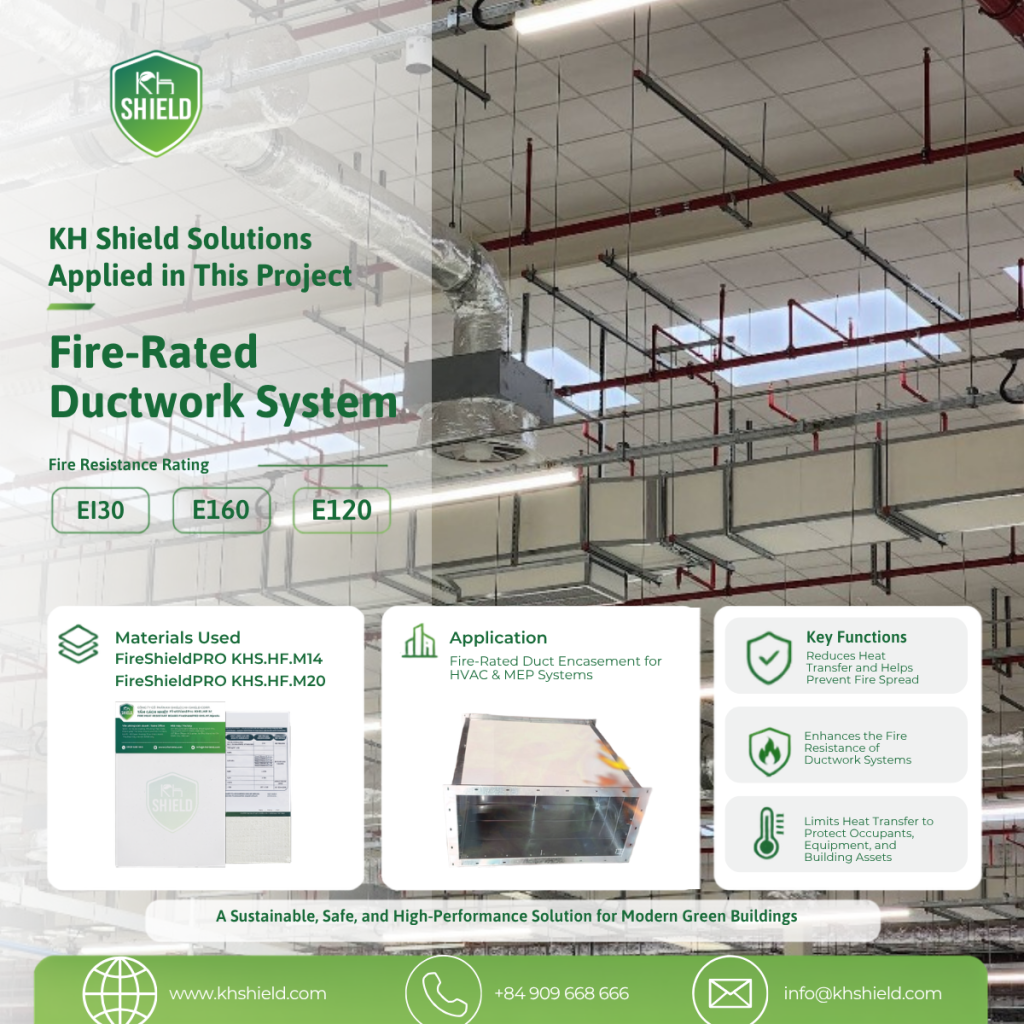
At LEGO Binh Duong, FireshieldPRO KHS.HF.M14 and FireshieldPRO KHS.HF.M20 insulation boards are applied to the EI30 – EI60 fire-rated ductwork scope, contributing to the passive fire safety system inside the project.
This is an important technical detail, but it also opens a broader perspective: in ESG-oriented FDI factories, fire-rated, fire-stopping and insulation materials are no longer secondary technical items. They are part of the strategy to build safer, more sustainable and more risk-controlled facilities.
LEGO Binh Duong and a Higher Sustainability Standard for FDI Factories
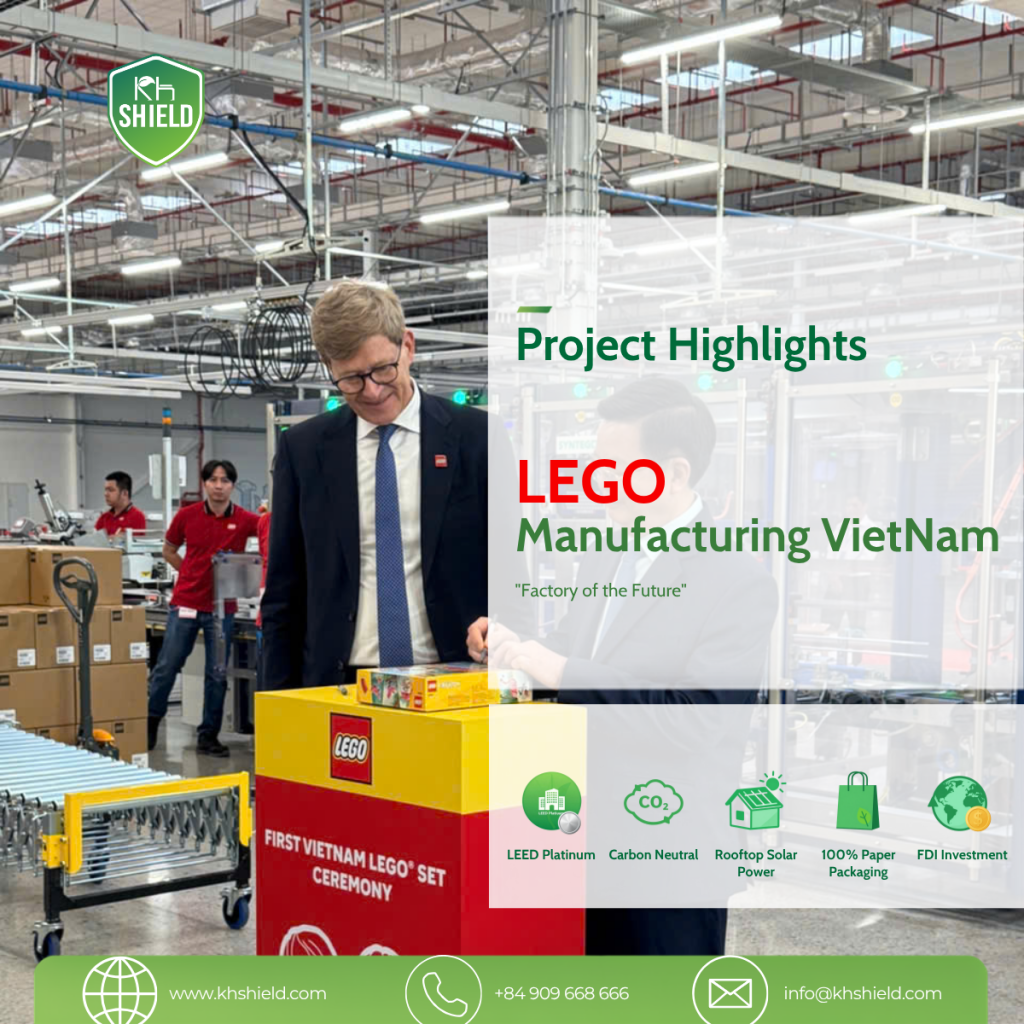
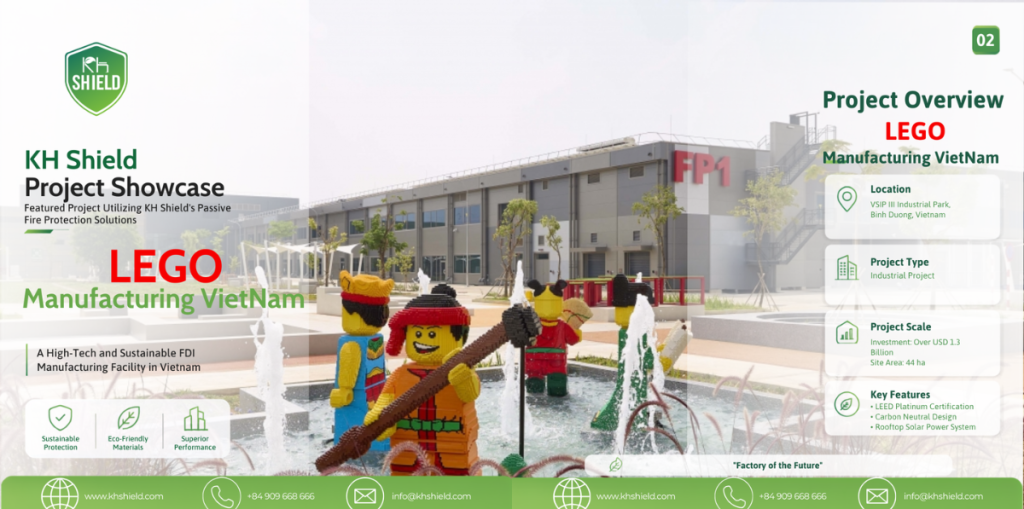
LEGO Manufacturing Vietnam is located in Binh Duong Province, one of Vietnam’s key industrial regions. The project was announced by the LEGO Group as its sixth factory worldwide and second factory in Asia.
What makes LEGO Binh Duong significant is not only its investment scale or its role in the regional supply chain, but also its sustainability direction from the beginning. According to the LEGO Group, this is the company’s most environmentally sustainable factory to date.
The factory is designed to run on renewable energy, supported by rooftop solar panels, an energy centre and battery storage solutions. Its main buildings have also achieved high-level LEED certifications, showing clear requirements for energy, water, waste and building quality.
For large-scale FDI projects, construction standards are no longer limited to schedule, capacity or investment cost. International investors increasingly pay attention to:
- Energy efficiency.
- Lower operational emissions.
- Workplace quality.
- Worker safety.
- Technical documentation and risk control.
- Long-term compliance throughout the building lifecycle.
This is why technical scopes such as fire-rated ductwork, insulation materials, fire-stopping materials and passive fire protection solutions are becoming increasingly important in modern factories.
ESG Is Not Only About Renewable Energy
In industrial projects, ESG is often associated with visible elements such as solar power, energy efficiency, emission reduction, water management or waste control. However, ESG in factories also includes how a facility protects people, maintains stable operation and controls operational risks.
ESG consists of three pillars: Environmental, Social and Governance.
Environmental – Reducing Operational Impact
In FDI factories, the environmental pillar is reflected in how the facility uses energy, water, materials and manages emissions. Renewable energy, energy-efficient design, suitable materials and optimized operation all help reduce environmental impact.
Social – Protecting People Inside the Facility
The social pillar is not only about employee welfare or workplace experience. It also includes the responsibility to protect users and workers inside the facility. This is especially important in factories with large workforces, complex technical systems and continuous operation.
Escape routes, technical corridors, ventilation systems, smoke extraction systems, fire-rated ductwork and fire-stopping materials are all directly related to user safety during an incident.
Governance – Controlling Standards and Operational Risks
From a governance perspective, an FDI factory requires clear technical systems, suitable material documentation, quality-controlled construction solutions and traceability during operation. This is particularly important for international corporations with strict requirements for compliance, safety and risk management.
Therefore, in an ESG-oriented factory, passive fire protection should not be seen as an isolated technical scope. It is an important protective layer that supports operational safety and long-term sustainability.
The Role of EI30 – EI60 Fire-Rated Ductwork in Modern Factories
In industrial facilities, ductwork is an important part of the MEP infrastructure. It is related to ventilation, air supply, smoke extraction, air distribution and the indoor operating environment.
In the event of a fire, ductwork that is not properly protected may increase the risk of smoke, heat or flame spreading between areas. This can affect workers, equipment, production lines and the factory’s ability to maintain operation.
Therefore, EI30 – EI60 fire-rated ductwork is an important component of a factory’s passive fire safety strategy.
- EI30 indicates integrity and insulation performance for 30 minutes under the relevant tested configuration.
- EI60 indicates integrity and insulation performance for 60 minutes under the relevant tested configuration.
- The required EI rating depends on design requirements, application areas, applicable standards and project-specific technical documentation.
For FDI factories, the fire resistance duration of ductwork is not only a technical parameter. It is also part of a risk governance strategy that helps provide more time for incident control, evacuation support and limitation of fire spread through technical systems.
FireshieldPRO KHS.HF.M14 and M20 in LEGO Binh Duong’s Fire-Rated Ductwork Scope
At LEGO Binh Duong, FireshieldPRO KHS.HF.M14 and FireshieldPRO KHS.HF.M20 insulation boards are applied to the EI30 – EI60 fire-rated ductwork scope.
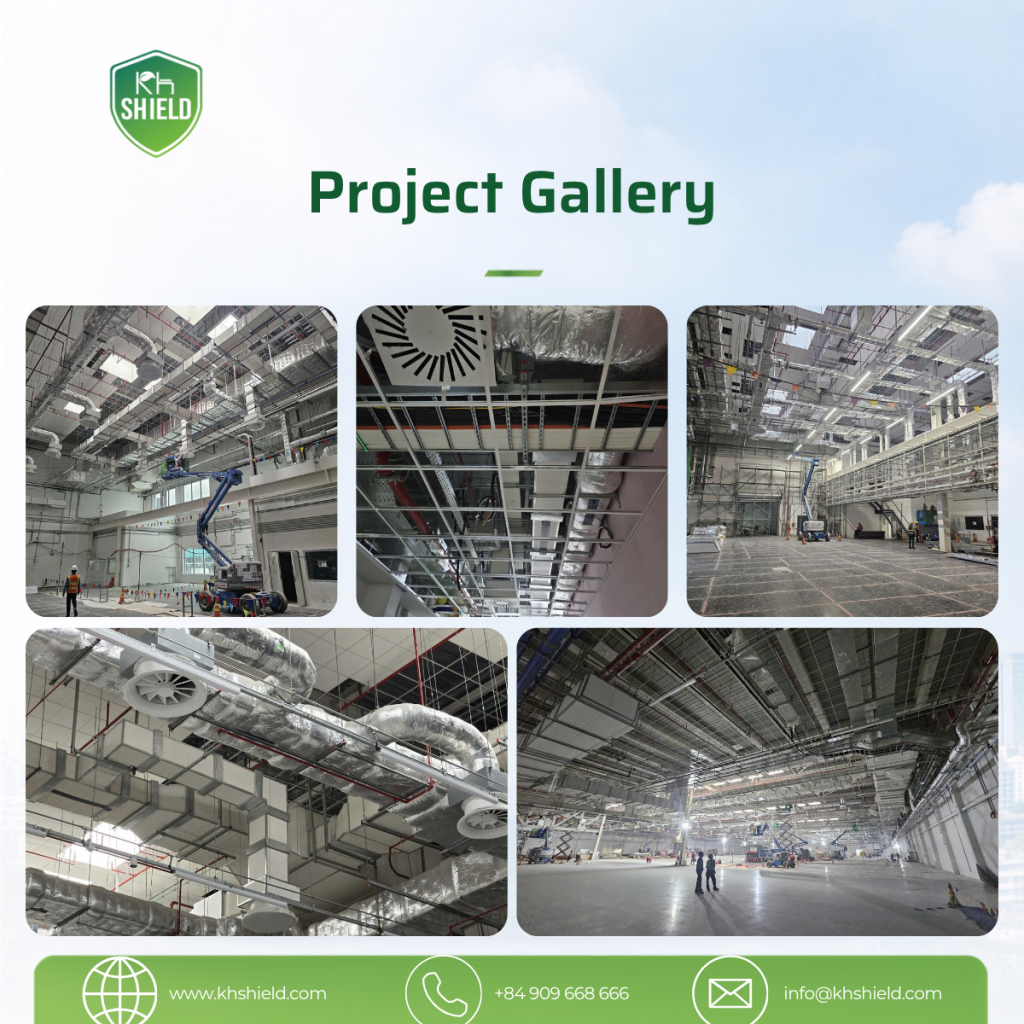
This is an important scope within the factory’s passive fire safety system. Given the characteristics of a large-scale industrial facility, fire-rated ductwork must meet multiple requirements: technical design compatibility, fire spread risk control, insulation performance and practical construction feasibility.
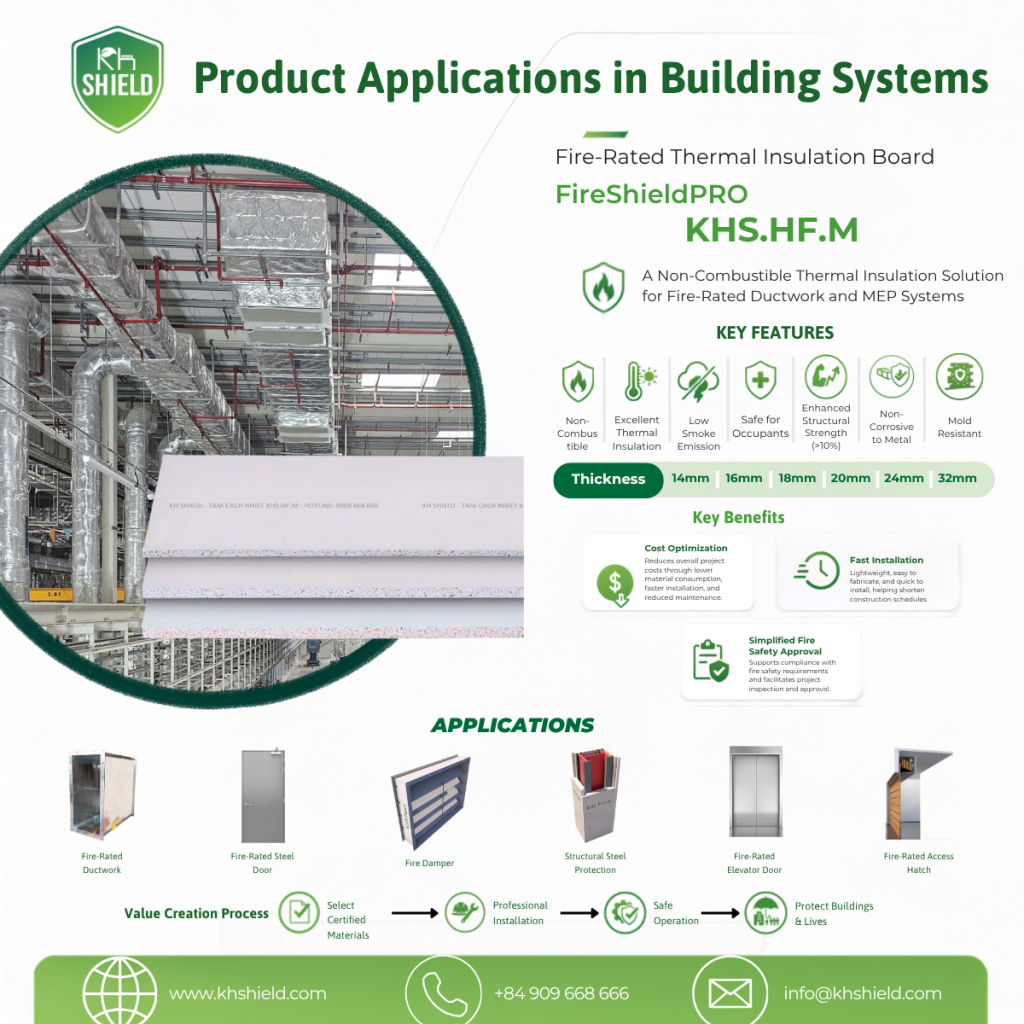
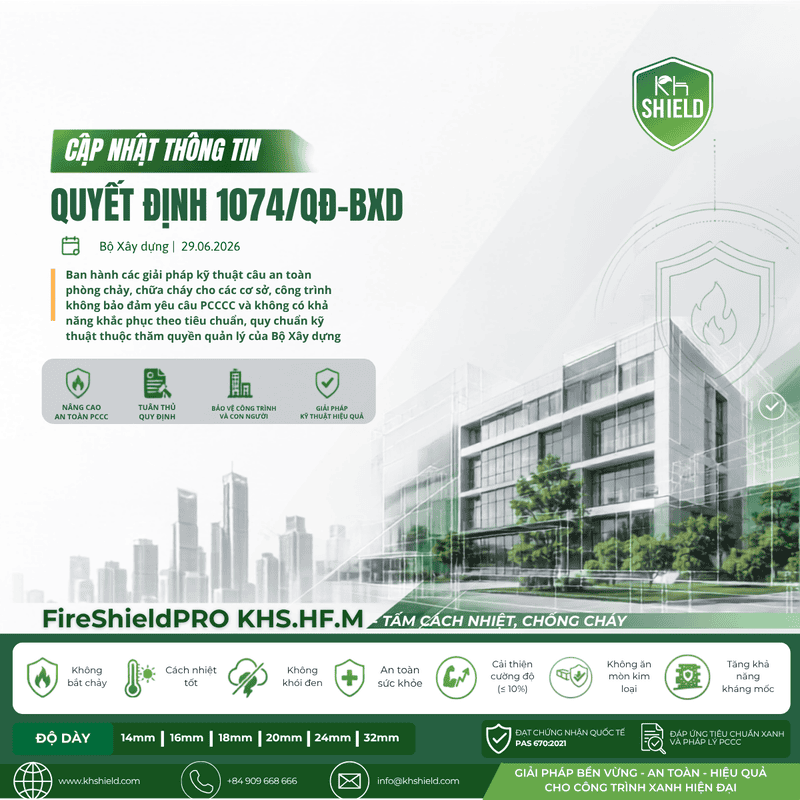
FireshieldPRO KHS.HF.M is an insulation board line developed by KH Shield for scopes requiring fire-rated, fire-stopping and insulation performance in combination with metal surfaces. The product can be considered for applications such as ductwork protection, fire damper protection, fire-rated partition cores, fire-rated steel door cores, insulated elevator door cores and other fire-stopping or insulation products.
In the context of FDI factories setting higher sustainability standards, using suitable insulation boards for fire-rated ductwork demonstrates the role of materials in completing safer technical systems. These materials may not appear on the exterior of the building, but they form an important protective layer inside the operational system.
KH Shield does not claim that its materials are the factor that helped the project achieve green certifications or the investor’s sustainability goals. The appropriate role should be understood as follows: KH Shield provides fire-rated, fire-stopping and insulation materials for technical scopes, contributing to the safety foundation inside the project.
Green FDI Factories Need Safety from Internal Technical Systems
A green factory is not only a facility powered by renewable energy or certified by green building standards. A green factory also needs operational stability, human safety, incident control capability and reliable technical systems.
For FDI projects, where operations are often linked to global standards, the requirements for materials and technical systems become even stricter. Investors, contractors and consultants should consider the following questions from the design and construction stages:
- Which ductwork systems require fire-rated protection?
- Which areas require EI30, EI60 or higher ratings depending on design requirements?
- Do the materials used for fire-rated ductwork have clear technical documentation?
- Is the solution suitable for real construction conditions?
- Does the fire-rated scope support long-term operational risk governance?
These questions show that passive fire safety should not be handled only at the end of a project. It should be part of the overall technical strategy of the building, especially for ESG-oriented FDI factories.
KH Shield in the Green Building and ESG Content Direction
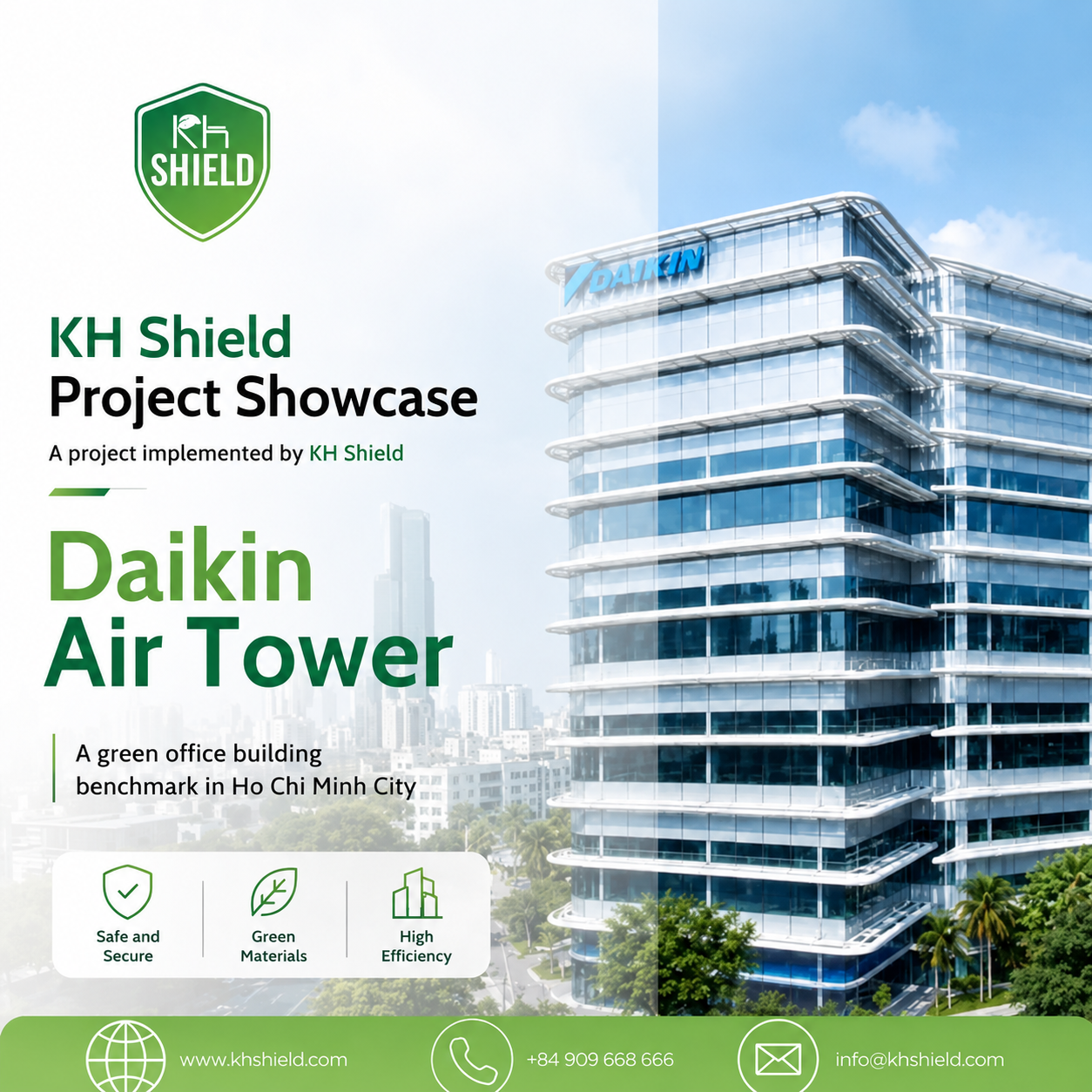
From Daikin Air Tower to LEGO Binh Duong, one common point can be seen in modern projects: sustainability standards are becoming higher, and they must go hand in hand with safety, materials and risk governance inside the building.
With Daikin Air Tower, the story is about the green office trend, where indoor environmental quality, operational efficiency and user safety are central.
With LEGO Binh Duong, the story moves to the FDI factory segment, where sustainability is linked to large-scale production, renewable energy, workplace environment and operational risk control.
In both content directions, KH Shield’s role should be communicated accurately:
- KH Shield does not claim to be the factor that helped a project achieve green certification.
- KH Shield does not limit the green building message to a single product line.
- KH Shield provides fire-rated, fire-stopping, insulation and safe finishing material solutions for suitable scopes in modern projects.
- In each specific project, KH Shield may participate through different products and solutions according to technical requirements.
For LEGO Binh Duong, the key communication point is: FireshieldPRO KHS.HF.M14 and M20 insulation boards are applied to the EI30 – EI60 fire-rated ductwork scope.
From LEGO Binh Duong to Responsible Material Selection
The emergence of large-scale FDI factories such as LEGO Binh Duong shows that Vietnam’s industrial construction market is entering a new phase. Projects are expected not only to meet production functions, but also to align with global standards for environmental, social and governance performance.
In this context, construction materials should not be selected only based on price or construction habits. Materials should be evaluated across multiple aspects:
- Compatibility with technical standards.
- Fire-rated, fire-stopping and insulation performance.
- Test documentation and traceability.
- Stability in construction and operation.
- Suitability for the safety, sustainability and ESG direction of the project.
This is why material solutions such as FireshieldPRO KHS.HF.M14 and M20 are relevant in technical scopes such as fire-rated ductwork. Although they may not be visible in the architecture, they are part of the internal safety layer of the building.
KH Shield Supports Modern Industrial Projects
With experience in fire-rated, fire-stopping and insulation solutions, KH Shield continues to support investors, contractors, MEP contractors and consultants in selecting suitable materials for different project scopes.
LEGO Binh Duong is a specific example of the role of FireshieldPRO KHS.HF.M14 and M20 insulation boards in EI30 – EI60 fire-rated ductwork. This technical detail is located inside the building, but it plays an important role in passive fire safety and operational risk management.
As FDI factories continue to set higher standards for sustainability, safety and compliance, fire-rated materials should not be treated as a late-stage add-on. They should be considered as part of the project’s design and operation strategy from the beginning.
KH Shield – Green from materials, safe from within.
Contact KH Shield for consultation on fire-rated, fire-stopping, insulation and safe finishing material solutions for FDI factories, industrial projects, office buildings, hotels, apartment buildings, shopping centers and modern developments.
Update the latest topic
Update highlights

Register for consultation
Consultation on fire and explosion prevention solutions