
 EN
EN

 09/09/2026
Thematic
Why Is There a Price Gap Between Chinese MGO Boards and KH Shield?

10/08/2026


Same EI60 Rating: Why Is There a Price Gap Between Chinese MGO Boards and KH Shield?
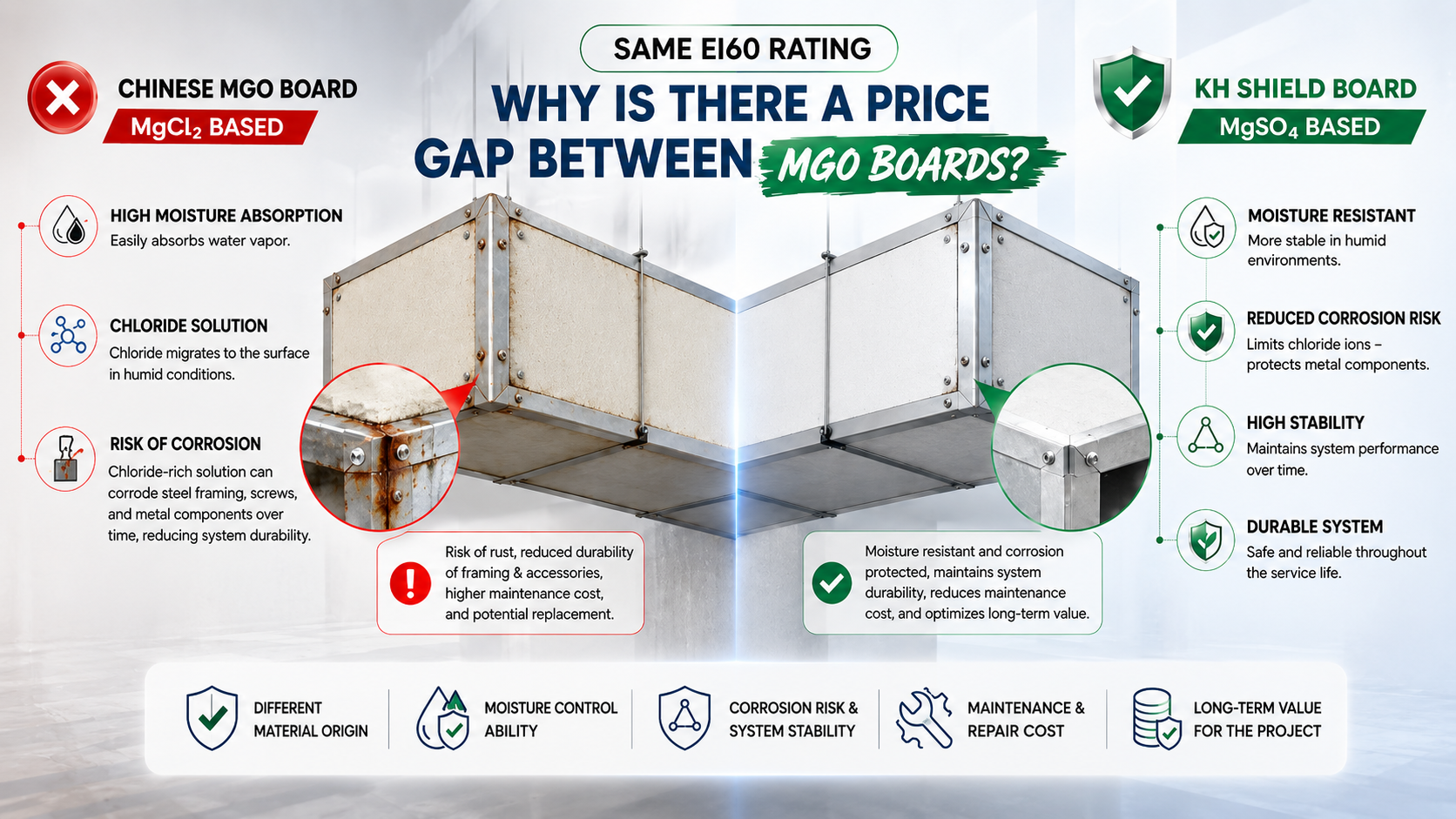
When selecting fire-resistant materials for a construction project, one common question is: “If both are MGO boards and both achieve an EI60 rating, why is there a difference in price?”
It is a reasonable question. However, EI60 is only one of the criteria that should be considered when evaluating a fire-resistant system.
To better understand the price gap, it is necessary to look deeper into the material composition, binder system, moisture control, stability, and long-term durability of the system under real construction conditions.
One notable difference among MGO boards is the type of salt-based binder system used:
- Magnesium Chloride-based MGO – MgCl₂
- Magnesium Sulfate-based MGO – MgSO₄
NỘI DUNG BÀI VIẾT
- How Are MgCl₂ and MgSO₄ Different?
- And the issue is not limited to the board itself.
- 1. Material Composition
- 2. Moisture Control
- 3. Corrosion Risk to Framing and Accessories
- 4. Overall System Stability
- 5. Life-Cycle Cost
- Don’t just ask: “Which board is cheaper?”
- Ask instead: “What additional value is that price difference buying for the project?”
How Are MgCl₂ and MgSO₄ Different?
Magnesium Oxide (MGO) boards are not simply composed of MgO. During manufacturing, the binder system and salt composition play an important role in determining the board’s performance characteristics.
For MGO boards using a Magnesium Oxychloride (MOC) system, MgCl₂ is part of the binder system. The key concern is that if soluble or mobile chloride remains in the material, particularly under high-humidity conditions, it can increase the risk of moisture absorption and the formation of salt solutions on the board surface.
In contrast, Magnesium Oxysulfate (MOS) represents a different material technology using MgSO₄. Comparative studies of MOC and MOS systems have shown that MOS can demonstrate lower moisture absorption and better corrosion protection under certain test conditions.
Why Does MgCl₂ Require Particular Attention in Humid Environments?
This is an important consideration when MGO boards are used in systems containing steel framing, screws, and metal accessories.
MgCl₂ is hygroscopic. When chloride-containing materials are exposed to high humidity over an extended period, chloride can attract moisture. If soluble or free chloride is present, absorbed water can dissolve these salts and form a chloride-rich solution.
This can cause saltwater to migrate toward the surface of the board, a phenomenon commonly referred to as “weeping.” Studies of chloride-based MGO boards have documented this phenomenon under high-humidity conditions.
And the issue is not limited to the board itself.
When chloride-containing solutions come into contact with:
- Steel framing
- Screws and metal fasteners
- Suspension rods
- Metal accessories
- Metal components located within or adjacent to the system
the risk of corrosion may increase.
Technical literature and practical studies have reported that dissolved chlorides in moisture released from certain MGO boards can contribute to corrosion of adjacent metal components.
This is particularly important for systems installed while a building is still exposed to high humidity, incomplete building enclosure, or frequent moisture exposure.
What Are the Advantages of MgSO₄-Based MGO Boards?
KH Shield uses a Magnesium Sulfate-based system – MgSO₄.
Unlike chloride-based systems, the use of a sulfate-based system is intended to minimize issues associated with chlorides in the material, thereby helping address moisture-related and metal-corrosion risks.
Notably, a study comparing chloride-based and sulfate-based MGO boards at 95% relative humidity found that the MOS samples in the study showed approximately 37% lower average moisture absorption than the MOC samples, while also demonstrating better corrosion protection under the test conditions.
This highlights an important point: when evaluating an MGO board, it is not enough to look only at its fire-resistance performance. It is also necessary to consider how the material behaves in the environment where it will actually be used.
So Why Is There a Price Gap Despite the Same Fire-Resistance Rating?
This is the point that is often overlooked.
A lower-priced product may offer a lower initial investment, but the initial material cost does not necessarily represent the total cost of a system throughout its service life.
When selecting fire-resistant materials, several factors should be considered together:
1. Material Composition
MGO boards based on MgCl₂ and MgSO₄ use different chemical systems, which can result in different moisture and stability characteristics.
2. Moisture Control
Construction environments can have high humidity, particularly before the building envelope is fully completed.
The material’s ability to absorb and retain moisture is therefore an important consideration.
3. Corrosion Risk to Framing and Accessories
If soluble chlorides are present and can migrate under humid conditions, chloride-containing solutions may come into contact with metal components and increase the risk of corrosion.
4. Overall System Stability
A fire-resistant system is not simply the fire-resistant board.
It consists of:
Board + framing + screws + adhesive + system configuration + installation conditions.
If one component deteriorates, the performance of the overall system may also be affected.
5. Life-Cycle Cost
The initial material price is only one part of the equation.
If the system later experiences moisture-related issues, corrosion, repairs, or replacement requirements, the total cost to the project owner may be significantly higher than the initial savings.
EI60 Is Not the Whole Story
EI60 answers one very important question:
Does the system meet the required fire-resistance and insulation performance under the conditions of the fire test?
But when the system is installed in a real building, additional questions need to be considered:
Is the material suitable for the actual construction environment?
How well does it control moisture?
Will the material and metal connections remain stable over time?
What will the maintenance, repair, and replacement costs be in the future?
That is why the same fire-resistance rating does not necessarily mean the same overall value or performance in real-world applications.
The Price Gap Is Really a Value Gap
When comparing MgCl₂-based MGO and MgSO₄-based MGO, don’t look only at the number on the quotation.
Look at the entire equation:
Material Composition → Moisture Control → Corrosion Risk → Stability → System Durability → Life-Cycle Cost
The difference between two products is therefore not simply a difference in material price.
It can also represent a difference in material technology, adaptability to real-world conditions, system stability, and the value delivered throughout the building’s life cycle.
Don’t just ask: “Which board is cheaper?”
Ask instead: “What additional value is that price difference buying for the project?”
Update the latest topic
Update highlights


Register for consultation
Consultation on fire and explosion prevention solutions